


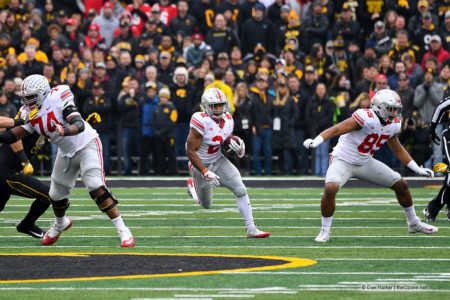
Ladies and gentlemen, boys and girls, step right up! Prepare to be amazed! Before you is one of the nation’s most unique talents, a man with a blend of speed, power, and elusiveness rarely seen before! Marvel as he makes defenders miss, turns nothing into something, and something into everything!
Ladies and gentlemen, what if I told you that by saying a few magic words, I can make this college football marvel… DISAPPEAR!
(There is a puff of smoke. As it dissipates, revealing an empty stage, the opening notes of “The Final Countdown” begin to play.)
Saturday afternoon in Iowa City, the Buckeye coaching staff pulled off this very trick… sorry… illusion, much to the delight of the thousands of Iowa fans. It wasn’t nearly as thrilling for those in attendance wearing scarlet and gray, who had already seen this show a lot recently.
In the first quarter, with the Buckeyes down 10-7, freshman RB J.K. Dobbins ran the ball four times on one drive. He picked up 7, 2, 35, and 3 yards on those carries. After the last carry set up 2nd-and-7 at the Iowa 10, the Buckeyes threw two incomplete passes and settled for a field goal.
On the Buckeyes’ first possession of the second quarter, Dobbins’ backfield partner Mike Weber carried the ball on four consecutive plays. He gained 8, 2, 9, and 3 yards, and that rushing threat set up a deep touchdown pass to Johnnie Dixon that re-tied the game at 17.


At that point, with more than 10 minutes left in the second quarter, the Buckeye backs had combined for 8 carries and 69 yards. The offense put up 17 points in less than 20 minutes of game action.
After that? POOF! Weber had one more carry for 5 yards, fumbled, and never took another hand-off. Dobbins rushed once for no gain in the second quarter and had a 4-yard carry on the first offensive play of the third quarter. Total: 3 carries for 9 yards in more than 40 minutes of play. Total points scored: 7.
Monday, OSU head coach Urban Meyer said that running backs coach Tony Alford is in charge of dividing up playing time for his unit.
“We have a conversation about it,” said Meyer. “Mike’s playing hard. I think J.K. is our starter, had a couple of nice runs. Those are things we talk about. But once again I think coach Alford does a nice job. (Dobbins) should have more than six carries, but we got behind and started throwing it a lot.”
The Buckeyes were within two touchdowns of Iowa until late in the third quarter, meaning that 10 minutes of the second quarter and 12 minutes of the third – more than a third of a game – elapsed between the “POOF” and the Buckeyes falling seriously behind.
Excluding a kneel-down before the half, the OSU drives in that span: 7 plays, 3 yards, PUNT; 4 plays, 18 yards, INTERCEPTION/ 3 plays, 6 yards, PUNT; 3 plays, 7 yards, PUNT. In those 17 plays, the backs got three carries. Barrett had six, including one wiped out by a penalty, but excluding a sack.
After a follow-up question, Meyer again deferred to Alford and pointed to the deficit as a reason Dobbins didn’t get the ball more.
“I think you have two quality tailbacks. I think that J.K.’s going to be a 1,000-yard rusher here pretty soon,” said Meyer. “Just the way the game materialized in that third quarter, there wasn’t a whole lot of runs after that point. But those are certainly conversations. J.K. deserves the ball.”
The return of the Incredible Disappearing Running Backs ended the same way it did against Oklahoma in September, Clemson in the Fiesta Bowl, at Penn State in 2016, against Michigan State in 2015… let’s just say that the show has been a fixture in Columbus for six years now.
That time period has spanned the Tom Herman, Ed Warinner/Tim Beck, and now Kevin Wilson eras at offensive coordinator. There is really only one constant.
Meyer rose to prominence on the back of a power spread offense. He turned Bowling Green into a winner, completed an unbeaten season at Utah, and won two national titles at Florida.
The offense works by spreading out the defense from sideline to sideline, then manipulating them with motion and reads to create numerical advantages they can exploit.
One key component of that is the read option, where the offense leaves one defender unblocked and the quarterback determines whether that defender is going after the running back or the quarterback. If he’s not going after the running back, the QB hands the ball off. If he is going after the RB, the quarterback pulls the ball and takes off running.
It’s relatively simple and can be brutally effective, especially when it’s run by a quarterback with breakaway speed like Braxton Miller.
The problem is, defensive coordinators know this too, and they know that they would rather see J.T. Barrett carrying the ball than J.K. Dobbins. Barrett is an effective runner. He had 14 carries for 63 yards against Iowa, including a long run of 18. But Barrett is not Dobbins. Barrett averaged 4.5 yards per carry, Dobbins picked up 8.5.
On the season, Barrett nets an average of 5.1 yards per rush, but Dobbins gets 7.7. Sack yardage hurts Barrett’s numbers a bit, but not nearly enough to make up the difference.
When defenses see the Buckeyes run the read option, or similar plays such as the speed option, they know they need to go after Dobbins. Barrett can hurt them, but Dobbins can kill them. That’s not a tough call.
The magic of the read option is that it forces the defense to make a choice, and thus leave one person uncovered. The downside is that it also gives the defense a unique ability to control who does – and doesn’t – get the ball for Ohio State.
While it’s certainly not all a function of the read option, the numbers remain clear, and the backs simply aren’t getting the ball. Dobbins had 29 carries in the season opener at Indiana and hasn’t had even half that number in any game since. Weber had 18 carries at Nebraska, but hasn’t topped 13 any other time.
Saturday, the Buckeyes will take the stage again, to face a Michigan State team well-versed in defending the OSU attack. The 2015 meeting featured star RB Ezekiel Elliott getting just 12 carries compared to 15 for Barrett on a cold, windy evening that ended in a 17-14 Spartan win that crushed OSU’s national title hopes. Last year, Barrett carried it 24 times, compared to a total of 18 for Weber and Curtis Samuel, as the Buckeyes survived a 17-16 nail-biter against a team that ended the year 3-9, and foreshadowed the offense’s collapse against Clemson.
The end of a magic trick, the moment of the big reveal, is called “the prestige.” The latest Incredible Disappearing Running Backs show revealed the Buckeyes’ national title hopes as an illusion. If the act returns Saturday at the Horseshoe, it could do some serious and long-lasting damage to the program’s prestige as well.