


I have been in several arguments over the past week or so.
They had nothing to do with climate change, which political party I belong to, or whether Kim Jong Un truly can reach us with a nuclear weapon.
No, somebody will just send me an email or leave me a voice message saying, “They need to expand the college football playoff …”
That’s enough to bring the gloves off.
Ah, the memories have come flooding back to me …
In the old days when polls annually determined college football’s national champion (from 1935-97), I used to always hear this from fans: “When are we going to have a playoff like the NFL?”
Then came the Bowl Championship Series, which pitted the two top-ranked teams in the Fiesta, Rose, Sugar or Orange Bowls to play for the national title, thus forever eliminating split national champions.
And I would hear, “This BCS is crap … when is there going to be a real playoff?”
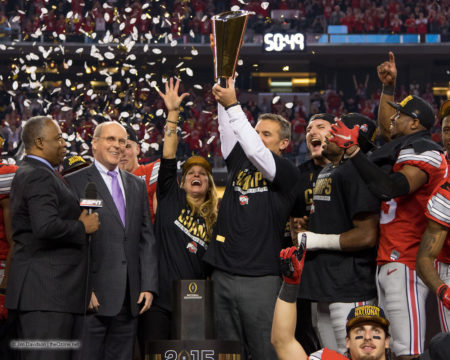
Finally, the powers-that-be instituted a four-team playoff system in 2014, and things went splendidly for the first three seasons as Ohio State, Alabama and Clemson were crowned national champions, respectively. (Outside of the Big 12 and its members, TCU and Baylor, getting peeved over the Buckeyes’ selection that first year, there hasn’t been much controversy.)
Until this past Selection Sunday.
Since, the College Football Playoff committee’s selection of Alabama (11-1), which did not win even the SEC West, over Big Ten champ Ohio State (11-2), as the No. 4, seed, all I have been hearing is, “When will the playoff system expand to eight – or better yet 16 – teams?”
My email inbox has been overflowing with angry Buckeye fans who feel jilted over the decision.
I will get right to the point: Expanding to eight teams would be a terrible idea. Expanding to 16 teams would ruin the game of college football.
“I agree completely,” Oklahoma Coach Lincoln Riley said. “We have a hell of a product here. We coach the greatest sport there is in this country – because there is no prolonged playoff system.”
Let’s go back to the beginning …
College football has been under constant evolution since teams from Rutgers and Princeton played the first-ever game in 1869.
The forward pass was invented and the “flying wedge” deemed illegal in 1906, in order to reduce the number of deaths and injuries that were plaguing the sport. Touchdowns, originally counted for two points, did not count for six until 1912. Leather helmets gave way to hard-shell helmets in the 1950s. Within a few years, face masks were introduced to reduce the amount of missing teeth and broken noses.
By 1936, a poll system was introduced to rank the teams and determine the game’s national champions. For the next 38 years, voters (coaches and media members) voted, the polls were released and national champions crowned at the end of the regular season – before the bowl games were even played.
Sadly, I am old enough to remember national champions being awarded in early December. That all changed in 1974, when the poll-makers agreed to wait until the New Year’s Day Bowl games were played before naming their respective No. 1 teams.
You may not be old enough to remember it, but that was real progress.
Many earlier years provided pure controversy, as schools claimed bias that their teams were not crowned national champions. A few of the infamous split titles occurred in 1954 when Woody Hayes’ fourth team claimed the Associated Press title and UCLA the United Press International title; in 1970, three teams claimed titles; in 1978 in which USC and Alabama split; in 1990 with Colorado and Georgia Tech; and as recently as 1997 when Big Eight champ Nebraska finished unbeaten but was slotted for the Orange Bowl, where it beat Peyton Manning’s Tennessee team, to be voted No. 1 in the coaches poll.
Across the country that day, Big Ten champ Michigan finished unbeaten and held off Washington State in the Rose Bowl and was voted No. 1 in the AP poll. (For the record, Tom Osborne’s Huskers would have kicked the dog-poo out of that Michigan squad if they had met on the field).
So then we moved on to the Bowl Championship Series. Remember the much-maligned BCS? Let me tell you, over 15 seasons, the BCS earned much less respect than Rodney Dangerfield, believe me.
Still, from 1998-2013, the BCS determined the sport’s national champions and resulted in some of the most memorable championship games in the sport’s history.
Who could forget Ohio State’s remarkable upset over No. 1 Miami, which rode a 34-game winning streak into the 2003 Fiesta Bowl? Or Texas’ rally to upset USC in the 2006 Rose Bowl — deemed the most-exciting finish in the sport’s history. Under previous arrangements, Miami would have gone to the Orange and Ohio State to the Rose Bowl in 2002; Texas would have gone to the Cotton and USC to the Rose after the 2005 season.
But even the BCS wasn’t enough.
So college presidents approved the playoff system we have today and ESPN promptly ponied up a remarkable $7.3 billion in a 12-year contract to televise all the playoff games, and immediately was overjoyed with the overwhelming ratings. The first semifinals were witnessed by approximately 28 million viewers for each game. Ten days later, more than 35 million viewers witnessed the first playoff title game, which Ohio State won by beating Oregon.
There would be plenty of viewers, but would college football teams have enough healthy bodies to put on a good show?
Ohio State Coach Urban Meyer addressed the issue three years ago, saying the NCAA-mandated 85 scholarship limit per school would need to be increased if the playoff field was increased.
“You can’t do that,” Meyer said of possible expansion during that first playoff run in 2014. “You better give us 110 scholarships then … when [it moved to] 85 scholarships there were only 12 games. Now there are 15 (if a team reaches the championship game) and the last three they added aren’t against smaller [schools]. They’re heavyweight prizefights. Our last four games will be against Michigan, Wisconsin in the Big Ten Championship Game, Alabama in the Sugar Bowl and now Oregon. Those are big-time, physical football games. The Alabama game alone was a sledgehammer of a fight.”
Expansion is a bad, bad idea. On so many levels.
For so many reasons:
CONFERENCE TITLE GAMES WOULD LIKELY BE GONE
As it is, the four-team playoff simply added another game – the championship game. An eight-team playoff would add four more games, and another week to the season. An unthinkable 16-team playoff would add 12 more games and two more weeks to the season.
There isn’t another week, let alone two, on the college football calendar in December in which to pull it off – unless they eliminated the conference championship games.
“I like it as it is,” Clemson Coach Dabo Swinney said, “but if they expanded to eight, there is no way to do it but to eliminate the (conference) championship games.”
And if you counter by saying reduce the regular season from 12 to 11 games or even 10, then you are cutting revenue from hundreds of games from hundreds of schools (there are 130 schools in FBS football) to add four or eight playoff games. That makes no sense.
Remember, there were no conference championship games until 1992, when the SEC expanded from 10 to 12 teams and added a title game. Then the Big Ten, Pac-12 and ACC soon followed, since all the conferences had expanded to two divisions.
These title games generate revenue for all the conferences’ schools, not just the participants.
HOME PLAYOFF GAMES IN COLD WEATHER?
If there were playoff expansion, it would be impossible to do it without a seeding process in which the top seeds would host the first rounds, much like the Football Championship Subdivision (formerly Division I-AA) does it. It would be impossible to hold three rounds of games, let alone four rounds, at neutral sites.
Can you imagine Florida, Florida State or Miami playing a road playoff game at Michigan or Ohio State in December?
The fairness issue would be front and center and there would be constant debate over seeding. And if the playoff were expanded to eight teams, there will always be the ninth-best or 10th-best teams saying they were robbed of their right to make the playoff. Ditto for 16 teams.
Doesn’t ESPN pontificate for hours over the teams left out of the NCAA’s 68-team basketball tournament?
WHAT ABOUT FINAL EXAMS?
Football players are “student-athletes,” after all.
When would the first round of four games be held? It’s just a fact that most major universities hold final exams anywhere from Dec. 1-20 each year, ending before the Christmas break. And that would be the exact period of which first-round games would be played, unless the playoff stretched to mid-January, when the new semester/quarter has already begun at every university around the country.
“You know, our guys … they actually go to class, and they have final exams all next week,” Swinney said.
And this would also bring out the NCAA’s critics who want student-athletes paid, an equally dastardly idea.
Yes, go ahead and pay them – and watch all the non-revenue sports go the way of bell-bottoms and fuzzy dice and be abolished. Then we have a problem with Title IX, which declares there needs to be an equal amount of female athletes on scholarship as male athletes.
THE EXPECTED ATTENDANCE PROBLEM
If the playoff remained in neutral sites …
The fears BCS proponents had when moving to the four-team playoff was adding an extra bowl game per fan base. Would one team’s fan base be able to support two post-season games in a neutral site each season?
The Rose Bowl during the first playoff season illustrated this point. When Oregon faced Florida State in that first-ever semifinal, they were selling tickets outside that famed venue for as little as $15. And by kickoff, there were several thousand empty seats.
Since Florida State had played in the Rose a year earlier, and with Seminole fans not known as having a huge travel contingent to begin with, the fans who wanted to see them play this post-season seemed to be hoping they would win the Rose Bowl and then show up for the championship game in Dallas.
TV ratings made up the financial difference, but who wants to see these games played in front of empty seats?
And if the playoff were expanded, the problem grows worse. If there were neutral site games, in which a team advances from the quarterfinals to semifinals to championship game, no fan base is large enough to support three games.
For example, if Ohio State had to play a quarterfinal game in New Orleans, then a semifinal in Pasadena and a championship game in Tampa – in essence three bowl games in three separate locations – how many fans can afford to travel and see all three?
And the Buckeyes have one of the most rabid, loyal fan bases in the country. You put that scenario to Miami or Florida State or Mississippi State, let me assure you most fans would pick one of the three games to attend.
The result: Empty seats across the board for playoff games.
PLAYOFF EXPANSION SURELY WOULD KILL THE BOWLS
And what about the bowls, which have been a large part of Americana since 1935?
If the playoff were expanded to eight teams, it would be a death-knell for the bowl system, many believe. And let’s face it, bowl games and their traditions are unique to and have been great to college football as well as local communities, dating back more than a century to the first Rose Bowl. Ask many former college football players about their favorite moments as a student-athlete, and they will tell you it was a week of sun, fun and camaraderie with their teammates at a bowl site.
“Bowls still give the opportunity to a lot of teams to go to play in a bowl game and end their season with a win, and there is nothing wrong with that,” Swinney said. “All these other sports, only one team ends their season with a win.”
“Expanding the playoffs would minimize the importance of the other bowl games,” Alabama Coach Nick Saban said. “Remember, but last year two good players from two good programs chose not to play in their bowl games, because of their NFL future, and their teams were not in the playoff. And if we go to eight teams, it won’t be long after that people will be clamoring for 16,
“And I don’t care if we go to 68 teams, but they will still hold a two-hour show about who didn’t get in it — just like they do in basketball.”
Also, remember that bowl payoffs, in the millions per school, help pay for non-revenue sports. Do you know that Ohio State leads the country with 36 men’s and women’s intercollegiate sports? If you take away the bowls, and the number of teams that can participate in post-season games, many of major-college football’s 130 schools will begin cutting non-revenue sports such as field hockey, swimming and diving and water polo.
Is that fair?
Because I got news for you: The Purdues, Vanderbilts and Boston Colleges of college football aren’t making the playoff very often. So if you take away a source of income like a bowl game from them, they will be cutting their athletic budgets and the playing field will be even more lopsided.
All these issues seem to be moot for the real decision-makers, at least for the moment.
The executives of the playoff committee, the Power Five Conference commissioners and the university presidents – have said repeatedly that the playoff will remain at four teams for at least the length of the 12-year contract. Of course, all contracts can be amended.
“It’s a four-team tournament for 12 years,” College Football Playoff Executive Director Bill Hancock said. “There hasn’t been any discussion in our group about expanding.”
I have some insight into Hancock’s beliefs here. I worked for him when he was the BCS commissioner, and he asked me to write op-ed pieces and press releases promoting the BCS and then the four-team playoff, demanding I take a stance against expansion to eight or 16 teams.
He had the right guy, because it was like shooting fish in a barrel.
“Regular-season football is the best thing we have going for us in college athletics,” Hancock said. “Nobody wants to erode that. There is a tipping point, beyond which the postseason would begin to draw life out of the regular season. Nobody knows what that tipping point is, but it’s not four. We know that. It could be eight, and it could be 16.”
DIMINISHED RIVALRIES AND DIMISHED REGULAR SEASON
This is the most important point.
As it is, most traditional rivalries – Ohio State-Michigan, Auburn-Alabama, Florida-Florida State, USC-UCLA, Clemson-South Carolina and many more – are played during the final weekend of the regular season. They mean something beyond bragging rights.
These rivalries are the essence of college football, in my opinion.
Now if the playoff is expanded, what would Ohio State-Michigan mean if both teams were ranked in the top-10 and already playoff shoe-ins? Remember the 2006 showdown at Ohio Stadium between No. 1 and No. 2. What would that game mean if the playoff was stretched to eight teams? Or 16?
Not much.
Or Auburn-Alabama?
“Here’s what would happen for a team ranked that high – they may rest their starters,” Swinney said.
And if conference championship games also remained, what would this year’s Big Ten championship game have meant, if both Wisconsin and Ohio State – which would have held true – were each getting into the playoff? Why even play the game?
And why play the SEC title game, since both Georgia and Auburn would be getting into the playoff?
“Some of my greatest memories as a player were those bowl games,” Georgia Coach Kirby Smart. “Now if you increase the number of playoff teams, you devalue the end of the regular season. The final few weeks were play-in games for everybody still alive and that’s the way to go about it.”
God forbid we get to this point, because college football’s regular season is what has set it apart from these other watered-down sports over the past eight decades.
Just as the NFL has had 7-9 teams make the playoffs, college football surely would have three-loss teams make an eight-team playoff and even four-loss teams make the playoff if it were 16 teams.
Who in their right mind wants that?
“Hey, I like the NBA, but I don’t even watch it until the playoffs start. I mean, why bother?” Swinney said. “All of our games count. You lose one and you in trouble. You lose two, and in most seasons, you are out of the running. Every one of our games since November had a playoff feel.”
No, college football is great because the regular season is great. The sport is popular, it is crucial and it is relevant because the regular season is popular, crucial and relevant.
An expanded playoff would change all that. God forbid, it would make it just like the NFL or NBA.
As it is, college football is way better – and it always has been.
They can expand Medicare. They can expand the size of the latest LED TVs, and they can expand the size of iPhones … but the pro playoff-expansion people need to keep their hands off the game of college football.
Jeff Snook, a 1982 graduate of Ohio State, has written 12 books on college football.