


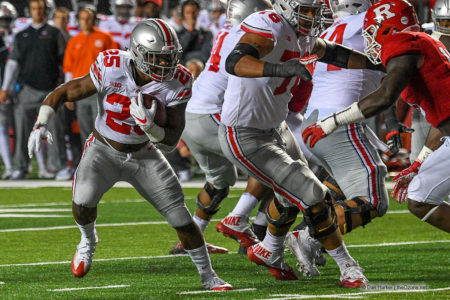
When running back Mike Weber announced that he was coming back to Ohio State for one more year, he committed once again to sharing carries with J.K. Dobbins.
As the starter and primary ball carrier in 2016, Weber shared totes with J.T. Barrett and Curtis Samuel. Yes, Barrett had more carries than Weber — 205 to 182, but many of those were scrambles on called pass plays. Weber was still the workhorse, but he certainly shared the load.
With the departure of Samuel after the 2016 season, Weber was expecting even more carries in 2017, but it never happened. Because of an injury this past season, it ended up being Dobbins who did the sharing with Weber.
Dobbins finished 2017 with 194 carries, which were 12 more than Weber had as a redshirt freshman. Weber, meanwhile, finished with 101 rushes while dealing with a hamstring injury for much of the season.
For any number of reasons, chief among them was likely a desire to improve his draft stock, Weber has chosen to return to Ohio State. The hamstring issue is a thing of the past now, and Weber and Dobbins will head into 2018 expecting to be the best running back tandem in the nation. And they would be right to expect that.
Together, they have 12 100-yard games between them — six a piece for the duo. They have different running styles, but both have shown they can succeed in Urban Meyer’s offense.
We got a pretty good preview of what 2018 could be with Dobbins and Weber during the Michigan State game this past season. Dobbins rushed for 124 yards and Weber pitched in a timely 162 yards on just nine carries. It was a rushing attack straight out of a video game, and there’s more where that came from.
In fact, there has to be more where that came from with J.T. Barrett gone. It wasn’t just Urban Meyer’s offense that found Barrett carrying the ball on short-yardage plays, it was Barrett’s ability to almost always pick up the first down when the Buckeyes needed it.
The thought of 25 carries dances in every running back’s head, but the reality is that too many of those 25-carry games can wear on a guy. And even though things might be going well in September and October, by the time November comes around, the load being carried can eventually create too much strain.
Weber understands that, which is why sharing the load at running back in 2018 suits him just fine.
“We want to be the workhorse, but I feel like that’s not a good thing in college football, especially in the Big Ten,” he said. “You want to have somebody else to get the ball to take some toll off your body.”
Unfortunately for Weber and the Buckeyes, he was paying a toll before this season ever began, and the bills kept coming due every week while he was dealing with his hamstring injury. Dobbins was able to step in and produce just fine, which is also a very significant benefit of a two-headed running back attack.
There are other benefits as well. Sometimes one guy has “it” and the other doesn’t. That’s when you ride the hot hand. Sometimes one back’s style is better against a particular defensive attack. And always, when the fourth quarter comes around, you have two fresher tailbacks, which is better than one tired runner.
Then there were the teases and hints of putting Weber and Dobbins together in the backfield. We saw a glimpse of it in the Cotton Bowl. Sprinkle in some Parris Campbell and you have the makings of a murderer’s row of home-run hitters.
Instead of 22 carries for one guy, Dobbins and Weber could put up 32 between them and everyone would be happy — especially Buckeye fans.
And as for Dobbins, he never expected to be the starter this year, and despite his rise to stardom, he has never lost himself in the shine. He has no problem sharing carries next season, especially if that is what is best for the team.
“I’m a young guy,” he said. “Anything to help the team and whether that’s me getting six carries or 14 or 29, that’s what matters to me.”
Mike Weber and J.K. Dobbins will be reunited in 2018, but what we saw in 2017 was just a trailer. The full motion picture could be epic.