


If you couldn’t tell from any previous writings I’ve done, I love special teams in football. I love kickers. I love punters. There you go. It’s out there.
As a fan of the Buckeyes since birth, I’ve been lucky to see two coaches who valued the kicking game.
That’s not to imply that Earle Bruce didn’t, but my memories of that at age four are a bit unclear.
John Cooper, well, I suppose that he may have as well. However, I attended a kicking camp at Ohio State in high school (circa 2000) and got a different impression. At said camp, Coop came into the meeting and hastily drew goalposts on the whiteboard. With our attention squarely on him, he said, “Try to put it here (drawing an X between the posts).”
That was his entire contribution to the meeting… and the camp. It was probably a joke. I get that. But it didn’t inspire me to think that he spent a lot of time pondering the ins and outs of special teams play.
Jim Tressel and Urban Meyer, on the other hand, clearly put thought into every aspect of the game, especially special teams. We know that Tressel placed the punt above all other plays. Meyer, likewise, uses his tremendous athletes to turn the tides in games, whether it be through punt blocks or kickoff strategy.
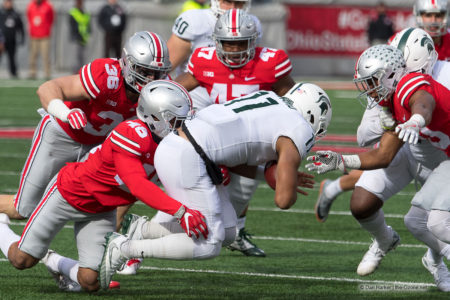
As a lover of special teams, I spent (too much) time watching every Buckeye kickoff of the 2017 season. I did this to gauge OSU’s current success on kickoff placement and coverage. It also gave me a feel for how Ohio State may adapt their kickoff strategy, given the new NCAA rules.
For those unaware, to reduce the number of kickoff returns and protect players, the NCAA will be awarding a touchback for fair catches made inside the 25-yard line. Outside of squib kicks and onside attempts, OSU only had three kicks fail to reach the 25. Two were pooched away from Saquon Barkley in the Penn State game and one was in windy conditions against Nebraska. Of those three kicks, only one return was attempted.
Urban Meyer, in his tenure at OSU, has directed his kickers to boot the ball high. He also asks them to aim between the five-yard line and goal line, and to land it between the numbers and the sideline. The strategy is to limit the return possibilities, forcing them down the side of the field. This method also leads OSU to pinch their coverage and stop the opponent well short of the 25-yard line.


To boost the odds of tackling them short, the Buckeyes even line up with the entirety of their coverage team on less than two-thirds of the field (as shown above). This completely disregards the area from the right hash to the sideline. In doing so, Ohio State must kick the ball where it intends, or they’re left out of position and vulnerable.
How did the scarlet and gray kickers fare in getting the ball into Urban’s targeted landing zone?
Not terribly well. Just 14 of the 104 total (non-onside) kickoffs this season landed in Urban’s ideal spot (0-5, numbers to sideline). Seven other attempts resulted in penalties, sailing out of bounds and delivering the ball to the 35-yard line.
Based on the 2017 kickoff results, either Meyer moved his preferred zone or the kickers didn’t feel it was worth the risk to aim so close to the sideline. Whatever the case, 49 (almost half) of the kickoffs last year landed between the left hash and the numbers. Now, in fairness, given the 75 yards between the kickoff spot and the back of the end zone and the width of the field, the area that he’s asking them to hit is about 1% of what lays before them. Not an easy task, despite what the angry gentleman beside you in C-Deck might yell.
What likely frustrated fans the most were the deficiencies in the kicking and coverage that led to leading the conference in out of bounds kicks (7) and kicks returned for touchdowns (2). A walk-on kicker, Bryan Kristan, booted his only kickoff out of bounds. Sean Nuernberger tried 15 on the season, resulting in one out of bounds, both returned touchdowns, and several squibs to avoid Barkley. Blake Haubeil, the team’s kickoff specialist, was responsible for the other five out of bounds blasts, but was otherwise respectable in his attempts.
So what does all of this mean for the Buckeyes in 2018?
I retired to the nerdery with my calculator, crunched a whole lot of numbers, and came up with a suggestion for the Ohio State kickoffs this upcoming season: Aim between the hash and numbers and hit it to the goal line.
The average starting position of all kickoffs that were received between the ten-yard line and goalline and between the left hash and sideline was the 22.5. This tally does not include those that went out of bounds. The underlying cause for those is the difficulty in trying to kick to such a small space. Toss those 35-yard line starts into the mix, and your starting position jumps up to the 24. That remaining field position advantage is negligible when compared to a 25-yard line touchback start.
If Haubeil directs his focus between the left hash and numbers, he gives himself a larger area to miss, drastically reducing the likelihood of any flags flying. In addition, if he is allowed to kick it further, the odds of a touchback increase and a long, damaging return decrease. This will also eliminate the kickoffs that failed to reach the ten-yard line. These short kicks resulted in an average field position close to the 30.
Give Blake Haubeil the green light to push it deep, without repercussion, and we’ll see upwards of 60 touchbacks. When kicks do fall short, it will be the returner’s responsibility to put the new NCAA rule into action. Many will know the smart play and will signal for a fair catch. However, a large percentage of returners also realize that this is their chance to hurt the Buckeyes. Those talented players will take their best shot. They’ll bet on themselves to be able to get beyond the 25 by returning it.
With the athletes that Urban continues to bring in and place onto kick coverage units, I’ll take that bet and place it on แทงบอลโลก.
Give me a kickoff to (or just beyond) the goal line, between the hash and numbers, and the statistics show that the coverage unit will make the play inside of the 25 a staggering 72% of the time. If not, and they play it safe by signaling for a fair catch, then the Buckeyes are simply back to defending at the 25.
It’s a minor adjustment to the current strategy. But with the rule change this method would allow the kicker the freedom to put more power into the kick. And by not asking him to drop it into a tiny area, it takes even more pressure off the kicker.
As John Cooper would say, “Try to put it here.”

