


Today’s Topic: Is the Transfer Portal Good for College Football?
Transferring has existed in college football as long as college football was a thing worth transferring to, but it’s never been quite like this.
Over thirty years ago, not seeing himself as a wishbone quarterback, quarterback Troy Aikman transferred from Oklahoma to UCLA. A few years after that, and for the same reason, Kent Graham left Notre Dame for Ohio State.
Transferring has been around for a very long time, and for almost every one of those years, coaches have been trying to limit transferring as much as they could.
The “year in residence” rule that forces players to sit out a year at their new school was done as a punishment and a deterrent, but painted as a “get your feet under you first before worrying about football” gesture of academic good will.
In 2006 came the graduate transfer rule, which allowed the “year in residence” to be bypassed for players who have graduated. Urban Meyer was the first well-known beneficiary of the rule, which was deemed “obscure” by the New York Times at the time, as Utah cornerback Ryan Smith transferred to Florida and started for the Gators as they won a national title that season.
Since that day, and even though the numbers are still quite small, graduate transfers have become the new normal, and I’m not sure there’s been a downside to it yet.
Another factor aiding transfers is the ability of social media to shame coaches who block transfers or won’t sign waivers granting immediate eligibility. Coaches can no longer block transfers, but they can still try to hold out on signing the waiver granting immediate eligibility. Twitter is undefeated in a lot of areas, and this is one of them. Every year, a coach or two tries to be strong, but eventually caves to the pressure of the vocal masses.
With the non-stop coverage, it may seem like the number of transfers is growing, but it’s actually been pretty steady for the last dozen years or so.
Could that be changing with the advent of the NCAA’s new Transfer Portal?
With a more user-friendly way of transferring, and a more lenient NCAA when it comes to eschewing the year in residence, transferring may be picking up steam, and what’s so bad about that?
As a person who enjoys the Hot Stove Leagues of the individual professional sports more than the leagues themselves, perhaps I’m the wrong person to answer this, but I don’t see a problem with it.
Fans may ask where the loyalty of players has gone, but I would change the wording from “loyalty” to “patience,” and there is probably nobody reading this who has grown in patience over the last decade or so.
We can have everything quicker and more immediate, be it movies, food, or 2-day shipping from Amazon. Everyone has less time. People are busier than ever. The loss of patience isn’t just a teenage issue, it’s societal.
So players are less patient than they used to be because patience is no longer the virtue that it used to be.
And there’s nothing wrong with that.
College is four or five years of a player’s lifetime, they should make the most of those defining years while they can.
Coaches will tell them that sticking it out builds character and the grass is rarely greener on the other side.
But those same coaches will also happily take a transfer at a position of need, not worried about any character that has yet to be built.
The transfer portal doesn’t change college football, it just changes the rosters a small bit. These are generally players who don’t think they’re going to play at their current school, so why should coaches or fans begrudge them a chance to go somewhere else?
Are most fans out there buying the jersey of a fifth-year senior who never made it as a starter and received just a smattering of fanfare on Senior Day? Are they even aware of a redshirt sophomore who has yet to make a tackle or catch a pass?
Of course not. And what percentage of the fans who scream about loyalty are also calling players every name in the book when they make a mistake on the field?
Where’s the loyalty there?
And let’s not try to paint coaches as anti-transfer, especially when they need players to transfer out every year so that they can get down to the NCAA-mandated 85 scholarship limit.
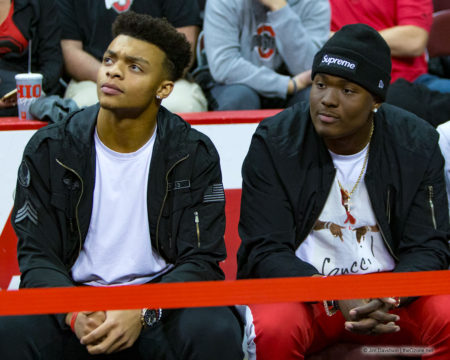
No, Ohio State doesn’t want to lose Tate Martell to transfer, and they didn’t want to lose Joe Burrow last year.
Transferring can definitely put schools in difficult situations. Burrow’s transfer put Ohio State in a bad spot a year ago. How did that difficulty end up? With Dwayne Haskins setting all kinds of school records and Joe Burrow becoming an LSU hero in the span of about three months.
I’d say that transfer worked out for both schools. I’d also say that’s what happens more often than not.