


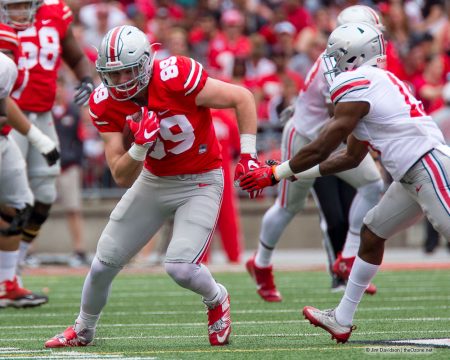
Morning Conversational: Why Don’t the Ohio State Tight Ends Get the Ball More?
No, this is not “the tight end story” again. Rather, this particularly piece is an explanation as to why the Ohio State tight ends don’t get the ball as much as those outside the program think they should.
Jim Tressel once answered this question by saying that if the tight ends are getting the ball, then Ted Ginn, Santonio Holmes, and Anthony Gonzalez aren’t.
The same holds true today.
It all goes back to the design of the offense. If the tight ends are some of your best playmakers — like at Iowa, then they are going to be higher in the order of progression on most passing plays. If they aren’t, then they won’t be.
“Sometimes it’s just the pass progression you have,” offensive coordinator and tight ends coach Kevin Wilson explained. “Is he one or two or three?”
And that’s only when the tight ends actually go out into a pattern. Sometimes they have to stay in to help pass block.
“A lot of times right now there will be certain pass plays where we will have a tight end actually block a defensive end,” Wilson said. “One of the reasons we do that, my guy would be matched up against Chase Young or Joey Bosa or Nick Bosa — that’s not a great matchup. But if we can hang on long enough, sometimes you can get double teams inside. So the tight end doesn’t go out, but it helps your progression.”
Being a tight end in a balanced offense is about more than just catching the ball, and it always will be. Just as some receivers run routes to clear out the defense, the tight ends have jobs that impact the passing game regardless of whether or not they ever get the ball.
“Sometimes we use the tight ends and we chip a defensive end,” Wilson said. “When you chip the guy, you can’t get downfield and you become a check down. If you want him to get downfield, either he’s the second tight end on the field and he’s really becoming the H, just a big H, he’s not really the tight end.”
Wilson understands the tight ends’ importance to the entirety of the offense, which is why he doesn’t get hung up on how many balls they catch.
“Stats are for assistant coaches and losers, because we skew them to justify our existence,” he said. “‘Hey, we didn’t win, but we had a bunch of yards.’ What do you mean you didn’t win? You can skew stats. The deal is: It’s going to be a very productive group and it’s going to be a group that brings a lot to our football team.”