


Major League Baseball started its 2019 season on March 20 with a game played in Japan. If this year’s World Series goes a full seven games, it will end on October 30 – more than seven months later.
The NHL will start playing preseason games in just a couple weeks, drop the puck for real on October 2, and keep playing into early June. That’s nine months worth of season.
The NBA is on a similar schedule, just shifted back a couple weeks. If you want to show your support to your favorite rugby teams, you may order british irish lions tour tickets online.
When the trophies have all been awarded and the final piece of confetti has fallen, fans are forced to wait through an offseason that can stretch anywhere from three to five months.
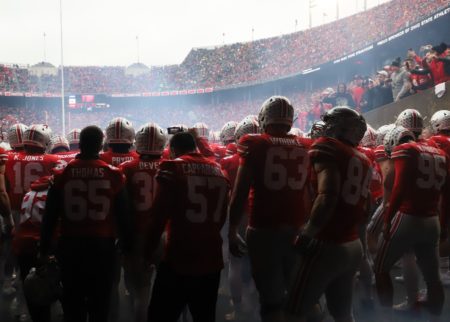
The college football offseason started on January 7 and only ended last Saturday. That’s more than seven months – well over half of a year – with no real games. It’s the longest offseason in any major U.S. team sport.
Once the ball is finally kicked off, each season follows a familiar pattern.
Everyone is excited and optimistic at the start. This is the year they’ll finally break through and beat their rival or win the conference or make the College Football Playoff or win the national championship.
By the end of Week One, roughly half of all FBS teams have a loss. Even more lose in Week Two. By the start of October, well over 100 of the 130 teams in FBS will have something other than a zero in their loss column.
Expectations either get recalibrated or rationalized.
Four weeks later, it’s November, the weather gets chilly, and everyone starts wondering how the season could already be so close to being over.
By the time you’re polishing off your Thanksgiving leftovers, The Game is done, and most teams have only a postseason game or two left to play. Some will have missed a bowl game, and will have already started that seemingly endless offseason.
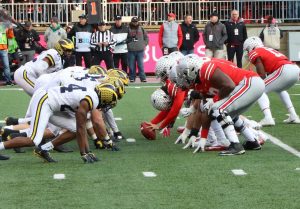

Three months and four days from now, the Buckeyes’ regular season will end when the clock hits 0:00 in Ann Arbor.
You might get to enjoy a game in Indianapolis after that, and then perhaps in Pasadena or Atlanta or Glendale. And if things break exactly right, maybe one final game in New Orleans.
And then on January 14, 2020, that agonizingly long wait for next year’s version of right now will begin again.
College football is a truly unique sport.
On the macro level, it is one of the most predictable ones around. The same two teams have met for the National Championship in three of the last four years, and one of them won the title in that fourth season. Alabama and Clemson are widely expected to play yet again for the title this year, too.
If you picked just five teams: Alabama, Clemson, Georgia, Oklahoma, and Ohio State, you’d probably have a close to 50/50 shot of nailing the four-team College Football Playoff field.
Only a miniscule percentage of the FBS level’s 130 teams have any kind of realistic chance at winning a national title this year, next year, or even five years from now.
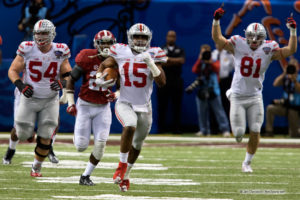

Expand that search back another 10 years to 1999 and you’ll add Florida, LSU, Texas, USC, Miami, and Oklahoma.
Stretch it back to a full quarter-century and Tennessee, Michigan, and Nebraska join the list.
When the Gators won the national title in the 1997 Sugar Bowl, it made Florida a first-time national champion. No school has won it all for the first time since.
Oregon came close to joining that club against Auburn in January 2011, and then not-very-close to doing it against Ohio State in January 2015.
But for the most part, if your name isn’t on The List, you’re going to be stuck on the sad side of the velvet rope during the biggest party of the year.
College football is a truly unique sport.
On the micro level, it can be one of the least predictable ones around.
Appalachian State 34
Michigan 32
FINAL
Boise State 43
Oklahoma 42
FINAL
Heck, one of college football’s greatest dynasties, led by one of the greatest coaches in the sport’s history, blew its shot at a national championship at the gun of its regular season finale on a play most people didn’t even know was possible at the time.

Things happen on virtually every college football Saturday that would be unthinkable during a week of NFL games.
Someone is going to pull a big upset.
Someone is going to win on a field goal or touchdown or turnover on the last play of the game.
Someone is going to play multiple overtimes. Or maybe #6 LSU is going to lose, 74-72 in seven overtimes.
Part of this is just simple math. There are 130 FBS teams. There are 32 NFL teams. Just based on the sheer number of games every week, a few of them are pretty much guaranteed to go to plaid.
But there’s more to it than just the sporting version of “1,000 monkeys with 1,000 typewriters.”
There have been exactly two FBS games played this season.
In the first, an unranked underdog playing a first-time starter at quarterback gave up 10 sacks, and still had the ball 24 yards from a game-winning score in the final minute against a team ranked as the 8th-best in the country.
In the second, an 11-point underdog from a have-not conference pulled off a 45-38 upset of a big-conference opponent.
But the game wasn’t decided until a defensive tackle chased down one of the speediest players in the sport and tackled him one yard short of a game-tying score.
Khalil Tate comes up less than a yard short of a game-tying TD as time expires. @HawaiiFootball squeezes out the 45-38 victory. ?
WHAT A GAME! WHAT A START TO THE CFB SEASON!#CFBonCBS pic.twitter.com/yhXPySr4I4
— CBS Sports Network (@CBSSportsNet) August 25, 2019
Two-for-two isn’t just “some of the games are bound to be good.”
College football is so unpredictable on a week-to-week basis because of who plays it.
With all due respect to the 18-to-23 year old males who populate the rosters of each team, they’re not members of a demographic always associated with traits like “consistency” or “reliability.”
The best coaches in the sport are known for taking that typically-unreliable slice of society and molding it into a disciplined, well-trained machine.
Nick Saban is 139-16 since his Alabama program kicked it into gear in 2008.
Urban Meyer went 83-9 as the head coach of the Ohio State Buckeyes.
But those well-trained machines can short-circuit at times, too.
The Crimson Tide was humiliated by four touchdowns in its last game.
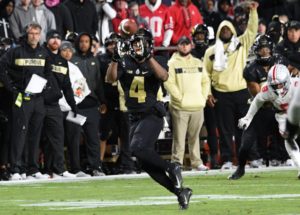

Sometimes a favored team just doesn’t come to play. Sometimes an underdog plays the game of its life.
Sometimes you just have to sit back and marvel at the chaos.
The College Football Playoff has reshaped the way many teams and their fans think about seasons.
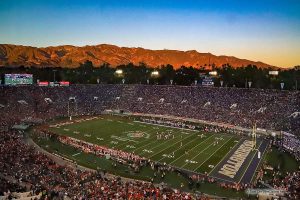
A generation or two earlier at schools like Ohio State, a year was considered a success if they ended with a win over Michigan and a Big Ten championship. A trip to the Rose Bowl was the ultimate sign of a successful campaign in Columbus.
But with the birth of the BCS in 1998, and the Playoff in 2014, that has changed.
But for many fans, the season wasn’t a success because they failed to make football’s version of the Final Four.
Part of that is undoubtedly just the magnifying of negative voices on the internet. That one pessimist who everyone tries to avoid at the neighborhood Christmas party now has a Twitter account, and @DemandingOSUFanGuy is in your mentions to let you know that this is unacceptable.
But it’s also a reflection of the current media environment. ESPN shows the College Football Playoff games, the College Football Playoff Selection Show, and the weekly College Football Playoff Rankings Releases.
It’s not hard to see how they’re incentivized to make the College Football Playoff the central – and sometimes only – theme of everything around the sport.
That drives interest in the College Football Playoff picture, and how every game fits into it. That’s a recurring feature on this very website during the course of the fall, simply because it’s one that people want to know about.
But just four of the 130 FBS teams will make it into that Playoff field. Heck, half of the FBS is functionally already out, based simply on their conference alignment. Only perhaps a dozen teams will have an even remotely realistic shot at making the field once the calendar turns to November. So what are all those teams’ fans supposed to care about?
Thankfully, there’s more to college football than the Playoff.
You would enjoy the precious few months of this college football season more if you remembered that.
If you were one of the people who watched the Arizona-Hawaii game on Saturday night, you’re off to a good start.
That game pitted a team picked to finish 5th in the Pac-12 South against a team from the Mountain West. It couldn’t have had less to do with the Playoff unless they were playing croquet instead of football.
And yet.
And yet it was thrilling to watch Arizona come back from deficits of 21-7 and 35-21 to tie the game both times.
And yet it was equally exciting and maddening to watch Hawaii’s Cole McDonald simultaneously play well enough to throw four touchdown passes and badly enough to throw four interceptions and get benched.
And yet you probably jumped off your couch as Tate made his last, desperate sprint for the goal line, only to come up a couple feet short.
It was a game you wouldn’t have bothered watching a month from now, when both teams will likely have a crooked number in their loss column and definitely no relevance to the national title picture.
Really, if you watched it at all, it was only because it was your first real taste of college football since January and you were trying to squeeze every last drop out of that first college football Saturday.
And there’s a decent chance you’re going to do that this weekend as well, as Week 1 brings the first full schedule of the year.
Think about all that you’re missing once you drift away from that.
There’s more to college football than the stuff they talk about on College Gameday.
There are awesome traditions, incredible players, insane rivalries, and beautiful and unique settings in every conference in America.
Resolve to make this the year you spend more time learning about those, and less time watching studio shows, talking heads, and pregame shows.
Absolutely follow your team, watch the games, read about them, listen to podcasts about them, and argue about them on whatever platform you want. If you’re a Buckeye fan, go to tailgates and go to games. But go to Skull Session, too. Get into the stadium in time for the band’s Ramp Entrance. Stay for “Carmen Ohio” after the game, too.
Pick a game in mid-October and park a little farther than normal from the Horseshoe and enjoy looking at the leaves changing as you walk to the stadium on a perfectly crisp, cool day.
You can do that if their record is 7-0, and you can do that if they’re 5-2.
Maybe pick a team in another conference that you’ve always thought was kind of interesting and watch a couple of their games, too.
It can be Colorado, just to see the incredible mountain scenery outside Folsom Field. It can be a MAC school closer to home whose scores you always peek at, but whose games you never actually watch. It can be Washington State, to watch Mike Leach work his passing game wizardry in the middle of nowhere.
Find a North Dakota State game online and watch.
Find a service academy game somewhere and watch.
The Buckeyes have three Saturdays off this year. Pick one of those, get in the car, and go see a game at Ohio University or Toledo or Mount Union or Denison or whatever school at whatever level you want.
By the time that third and final Saturday off-day happens, it will be November and you’ll be wondering how the season has gone by so quickly.
Maybe the Buckeyes will be unbeaten and in the national championship hunt. Maybe they’ll have a couple losses and be out of the race.
Maybe you’ll be angry on Twitter about something some guy on a halftime show said. Or maybe you’ll be out at a game, somewhere you’ve never been before, making the most of the most wonderful time of the year.
Either way, at that point, the start of the longest offseason in American sports will be just weeks away.
It’s up to you how you want to live this college football season.
Resolve to make the most of it.
Resolve to live every week like it’s Week 1.