


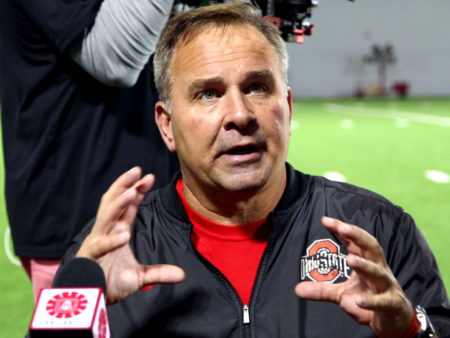
Today’s Topic: How Does Play Calling Work For the Buckeyes?
Every year, Ohio State’s head football coach is asked who is calling plays and how the process is done.
And every year, every head coach says essentially the same thing. It’s a collective effort and the roots start throughout the week in deciding which plays will be best against a particular defense, or which plays have been effectively executed by the offense throughout practice.
It is a much more complicated process than many people think.
After the plans are made during the week, it is then up to the coaches during game day to make sure they are calling the right plays at the right times.
Ryan Day was asked back in December if he would still call the plays and he said that decision hasn’t been made. However, since he also cited recent examples of head coaches who have called plays, it would seem he is leaning towards doing it himself.
That might sound like a lot of responsibility for a head coach with plenty on his plate already, but as Urban Meyer and Jim Tressel have said before, play calling is a collective effort with several voices being heard.
Last season, Ryan Day called the plays, but he sought help from fellow offensive coordinator Kevin Wilson. Urban Meyer would also let him know when he would like a particular play called.
Meyer is now gone, so Day will have the final say, but Wilson and co-offensive coordinator Mike Yurcich will have their input as well.
Let’s let Kevin Wilson explain the process.
“Each game can be different, and the flow of the game can be different,” Wilson said. “But Coach will interject with, ‘Remember, I like “X” pass, or this run, or can we get it outside?’ Sometimes it will be ‘Give it to me now’ or ‘Just don’t forget about it.’
“Sometimes the conversation is after the drive. ‘Hey, Kevin give us a couple of runs to get the run going.’ ‘Let’s get out here, we’ve got a one-on-one shot.’ Or ‘Let’s get Dwayne going.’ Whatever. Those conversations about just the flow of the game from Coach. Sometimes specifics, but more generalities. Some of it between the drive. A lot of the conversation is when the drive is ended.
“Next drive, Ryan will say, ‘Kevin, if you’ve got one or two runs that you really, really like.’ ‘Give me this one and this one.’ ‘Hey Ryan, if you need to in the pass pro deal, we need to maybe get a screen up. We need to chip that defensive end and help that tackle out.’ So I’ll get that in. I’m saying, ‘What are you thinking about your next couple of throws?’ ‘Hey, I’m having trouble. I’m worried about pressure.’
“So for example, ‘Hey Ryan, what do you think in your first third-and-long.’ ‘I like this.’ ‘Hey Stud, first third-and-long, we’re thinking this, be ready.’ ‘Hey third-and-short Ryan, what do you think?’ ‘I like this.’ ‘Hey Stud, remember they’re going to outside blitz.’ You’re anticipating. You’re a few plays ahead. Everybody talks about halftime adjustments, but we’re making little adjustments between drive of like, ‘Hey, remember, come back to this’ or ‘Let’s try this.’ And you just try to do it.
“Once we get going, Ryan is controlling the flow of the game, but you can’t have a lot of conversations because you want to play fast. It’s like, ‘Hey men, the defense is standing around, can we pick up the tempo?’”