Last year was the worst season of punt returning for the Buckeyes in Urban Meyer’s OSU tenure.
Ohio State returned more punts than 110 other teams (27) last year, yet they managed just one return of at least 20 yards. Only 18 teams in the nation were worse than that a year ago.
It was the second time in Meyer’s five years that the Buckeyes managed just one return of at least 20 yards. The other time was the 2013 season, which also ended in a loss to Clemson. Now, nobody is saying the two are related, but in 2017, it’s probably best to just avoid finding out if there is indeed a connection.
And it’s not like that one punt return went for 60 yards. It was a 27-yarder from Dontre Wilson in the second game of the season. It was all uphill from there.
How bad is just one return of 20+ yards? Well, in 2015, the Buckeyes had seven such returns, with three of them going over 30 yards. In 2014 — when Ohio State won a national championship, they had eight returns of at least 20 yards and two of at least 50 yards.
While there is no real correlation between lack of explosive punt returns and losing to Clemson twice, there is definitely a correlation between Ohio State’s national title and its ability to return punts well.
Given what Jalin Marshall brought to the offense and return game in 2014 and 2015, it could be argued that the Buckeyes missed him last year more than they did fellow receiver Michael Thomas.
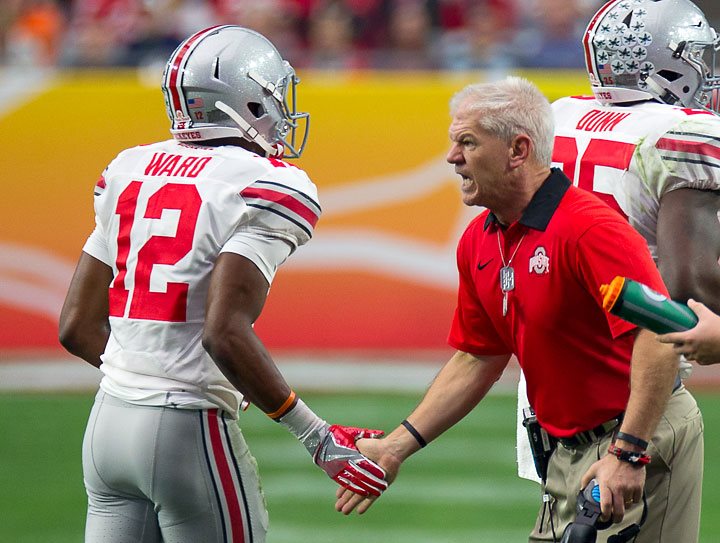
As special teams coordinator, Kerry Coombs can’t spend time reminiscing. The punts will be coming regardless, and he has to get the Buckeyes ready to return them.
Ohio State searched for answers throughout the season a year ago, even turning for a spell to freshman running back Demario McCall. McCall entered this spring as one of the favorites to win the job, but he also had competition from cornerbacks Kendall Sheffield and Denzel Ward.
“I think if we ran out there today it would probably be Demario, but I think Kendall could get it,” Coombs said back in the spring. “I haven’t seen anybody do it live yet. I can’t give you a great answer. It’s a lot different when you’ve got to catch a ball with a bunch of guys breathing down your neck than catching it off of a JUGS machine.
“But yeah, Kendall’s gonna be back in the return game. Denzel’s going to be back in the return game. We’re going to play some fast guys. Parris is going to be a dynamic (kick) returner. So I think we’ve got a larger group than usual to draw from in that area. I think we’ll have a rotation.”
Without an established return guy…returning…there is always going to be some question about who exactly can get the job done. There will be on-the-job training, and also the one thing you can never have in special teams — trial and error.
So how do they go about finding the right guy in the spring when they are in such a controlled environment? And what are the ultimate deciding factors?
“First of all, you chart every ball they kick in every practice,” Coombs explained. “So the first thing is ball security. So the guy who catches 100% of the balls is your first thought because a ball on the ground is a bad thing. So we chart every catch, and the next thing is what is their dynamic ability to score? That wasn’t a phase of our special forces that was good enough last year. We’ll be significantly improved this year. We’ve put a lot of time and effort into that. I can’t tell you who it is yet, but somebody’s going to emerge. I really believe that.”


