
College football recruits all across the nation will start signing their official Letters of Intent on Wednesday, during the new early signing period. Despite some uncertainty around a few high-profile commits, Ohio State is on the verge of signing the top football recruiting class in the nation, and one of the greatest in the modern era of college football recruiting.
It may seem absurd to have to write this, but here goes: This is a big deal.
A.J. Hawk was a 3-star linebacker recruit in the 2002 class. Mike D’Andrea was a 5-star linebacker recruit the same year. Hawk turned into a star, while D’Andrea didn’t. You probably know that already because it’s one of the classic examples the “RANKINGS ARE MEANINGLESS” crowd likes to trot out around this time every year.
You can probably name a bunch of highly-ranked players who didn’t pan out due to injury or off-field issues or any number of other reasons. There are also plenty of examples of scrappy 3-star “diamond in the rough” recruits like Pat Elflein or Darron Lee who blossom into standout players after arriving on campus.
Elflein was the lowest-rated member of the Buckeyes’ 2012 class, ranked as the 998th-best player in the nation, and the 61st-best in Ohio. He ended up winning the Rimington Award as the nation’s top center in 2016, and is now starting in the NFL. He’s clearly an example of “sometimes the system misses on guys.”
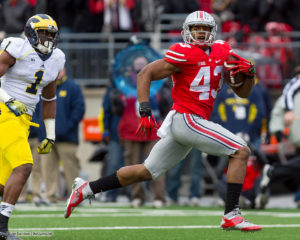
Lee was ranked as the 36th-best prospect in Ohio in the 2013 class, seven spots behind a guy who went to Eastern Michigan. He was a standout on the 2014 national championship team and is now playing on Sundays as well. The 37th-best prospect in Ohio that year? Tracey Sprinkle.
You can bet on 3-stars turning into superstars and be correct sometimes, just like you can bet on roulette and make a little cash. You can buck the odds for a while, but in the end, the rankings and the house always win.
It’s not a coincidence that the schools that end up at or near the top of the recruiting rankings every year also tend to end up at the top of the final polls, too. Over the past seven years, only two programs have finished with a top-10 class every year: Alabama and Ohio State. Five more have brought in six top-10 classes in seven years: Florida State, Georgia, USC, Auburn, and LSU.
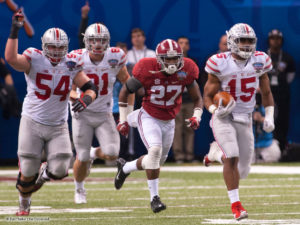
The top five programs in wins since 2011? Alabama, Clemson, Ohio State, Georgia, Florida State. That’s four of the seven schools named above, plus Clemson, which has never finished lower than 16th in the recruiting rankings over that span.
Every team that has won a national title during the Playoff era has done so thanks in part to at least one top-10 recruiting class. All four teams in this year’s playoff field have top-10 classes on their roster as well.
However, the relationship between Signing Day and on-field success goes much deeper. A 2013 study published at Ohio State found a statistically-significant correlation between the star rankings of recruits, and the likelihood that a team would reach a top-level bowl game. It also placed the average on-field value of a 5-star recruit at nearly half a win per year.
You can find plenty of other research that backs this up using a variety of different methods.
A 2014 article found that if you divide FBS schools into five tiers based on recruiting rankings, the higher ranked teams put up a winning record against everyone below them for four straight seasons.
Every BCS national champion in the modern recruiting era brought in more 4-and-5 star players than 3-star or lower rated players in the four years prior to winning the title.
Players who enter college as 4-star or 5-star recruits are 995% more likely to be selected in the first round of the NFL Draft than lower-rated players.
In 2013, research found that strong recruiting had a “definite and fairly strong correlation” with team success.
From 2012, this post concluded “recruiting rankings have a huge correlation to future team success.”
At some point, this stops being a coincidence.
So yes, sometimes a 3-star recruit like Malik Hooker turns into a dominating player. Some “can’t miss” prospects always somehow manage to miss. Sometimes a team whose recruiting classes rank in the 50s wins by 31 against a team that always places in the top-10. It’s college football, and it’s wildly popular because it can be so utterly unpredictable on a micro level.
But on a macro level, college football is a lot easier to figure out. If you’re predicting which teams will make the playoffs over the next four years, the list of top recruiting classes that start getting finalized Wednesday is a good place to start.
Coaches have an old saying that you can’t win a national championship during summer practice, but you can lose one. The same is true of Signing Day.
Wednesday, the Buckeyes should move just a little closer to returning to the top of the college football mountain.


One of the confounding factors is the limit on the number of 4 and 5 stars; which means there are probably as many guys of equal talent that wind up as a 3 star; you could simply toss all the names in a hat and pull them out and come up with an equally talented group.
Surprise??? Coaches have always saidit’s not the X’s and O’s, it’s the Jimmies and Joes!!
Malcolm Jenkins was another 3* player. He’s not doing too bad either. ?
It isn’t always the case of the system missing, as it is the system not being able to measure heart, desire, and development. Some guys have maxed out their potential as great HS players. Some have just opened the can of What can I do, and how far can I go?